Introduction
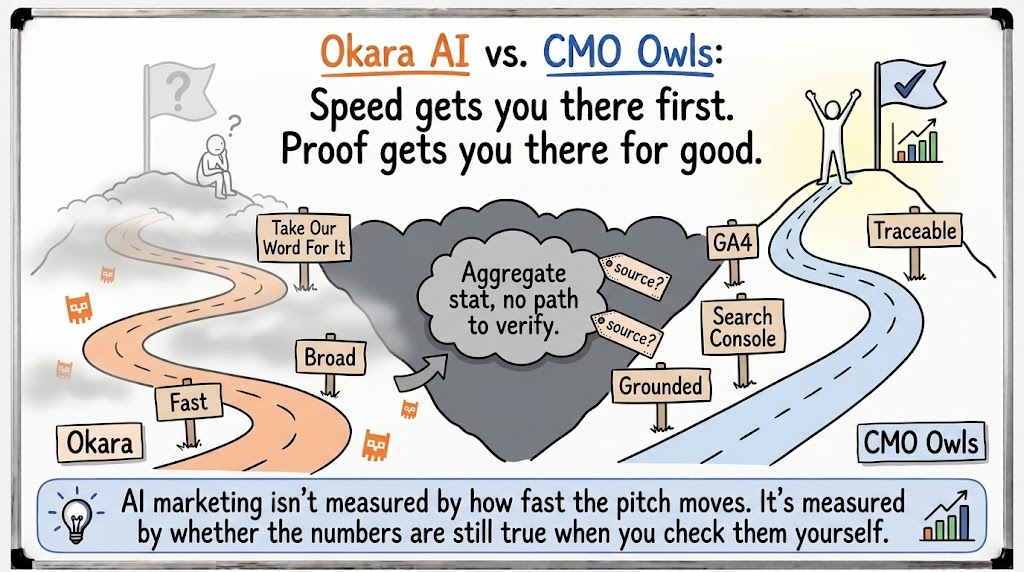
“Real” might be the most overused word in AI marketing right now. Every platform claims real data, real results, real strategy. Okara.ai and CMO Owls both use the word constantly, and so does most of the rest of the AI CMO platform category, which means the word itself has stopped telling you anything.
This article isn’t another feature comparison. It’s an AI marketing test: what actually happens when you stop reading the word “real” on a homepage and start checking whether it holds up, using Okara.ai vs CMO Owls as the two platforms under the microscope.
We Think “Real” Should Be a Testable Claim, Not a Tagline
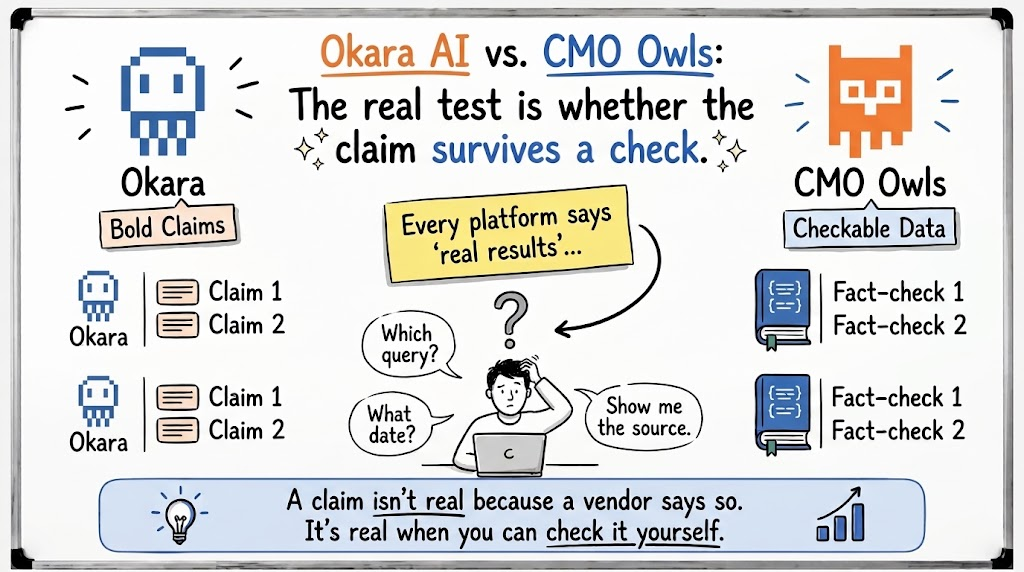
Both companies in this comparison put the word “real” directly into their own marketing. That’s not a coincidence, and it’s not necessarily dishonest either. But a claim you can’t verify isn’t worth more than a claim you can, no matter how many times it’s repeated. Real AI marketing should mean something specific enough that you, not the vendor, can go check it.
So instead of listing features, this article walks through three things people actually mean when they say a platform is real, looks at what each company’s own case studies show, and gives you a way to run the test yourself before you commit budget to either one.
The Three Things People Actually Mean by “Real AI Marketing”
Strip away the marketing language and “real” collapses into three separate, testable claims. Worth checking all three separately, because a platform can be honest about one and vague about another.
- Grounded in real data. Recommendations come from actual crawl results, real ranking data, and real traffic numbers, not a language model’s best guess at what’s probably happening on your site.
- Integrated into your real stack. Output lands inside the tools you already run on, your CMS, your analytics, your social accounts, instead of sitting in a document you have to manually copy into place.
- Accountable to a real, checkable outcome. The platform points you to a specific number in a tool you control, Search Console, GA4, your own dashboard, rather than an aggregate statistic you have to take on faith. That’s what marketing automation accountability actually looks like in practice.
Put those three together and you get verifiable AI marketing results instead of a testimonial you have to take at face value.
What the Case Studies Actually Show
Every AI marketing case study on a vendor’s own site is, by definition, the vendor picking its best example. That doesn’t make the numbers fake, but it does mean a single case study is marketing until it’s paired with a way to check it, not AI marketing proof on its own.
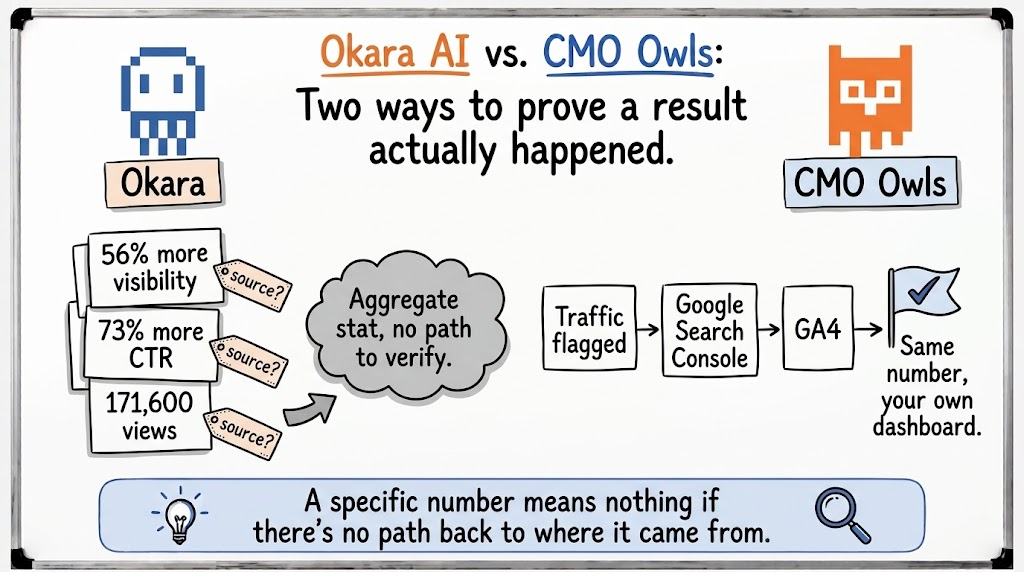
Okara.ai’s public testimonials include specific numbers: one customer reports a 56 percent increase in search visibility, a 73 percent increase in click-through rate, and 20 percent more U.S. traffic. Another cites 171,600 views in 24 hours from a creator campaign. Those are real numbers in the sense that they’re specific, not vague, but they’re presented as aggregate AI marketing metrics without the underlying methodology, so there’s no way to independently reproduce them from the outside.
CMO Owls takes a different approach to its own proof points: instead of leading with aggregate campaign statistics, it leans on deterministic marketing data, tying site health and traffic alerts directly to Google Search Console and GA4 rather than an AI model’s summary of what happened. The company also discloses its own build process (a year spent with marketing leaders before launch, a team with backgrounds at companies like Apple, Meta, Tesla, and Airbnb) as context for why it made that choice, not as a substitute for it.
Neither company’s proof points come pre-verified, that part is fair to say about any vendor. But the two approaches don’t leave you in the same position. A specific percentage with no visible source gives you nothing to go check. A number tied directly to Search Console and GA4 gives you exactly that, a path to confirm it yourself in a tool you already have open. What separates a testable claim from an unverifiable one is whether you, personally, can go check the number, and on that measure CMO Owls’ approach is the one built to hold up.
Those receipts already exist, several times over. Across pilot accounts run before CMO Owls’ public launch, the same Search Console dashboards this article keeps pointing you toward showed real, cumulative numbers: one account at 1.5M clicks and 32M impressions, another at 280K clicks and 20.6M impressions, a third at 400K clicks and 14.9M impressions, and a fourth at 23.6K clicks and 1.3M impressions. Every one of those numbers came from the same GSC export you’d pull for your own site, not from a dashboard summarizing itself.
For the specific ratings and complaints behind Okara.ai’s aggregate testimonial picture, see our Trustpilot review breakdown for Okara.ai, plus more reviews from LinkedIn and elsewhere.
Marketing Theater vs. Marketing You Can Audit
Here’s the practical version of the test. Open your own Google Search Console next to whatever dashboard a platform gives you. If a platform tells you traffic dropped 12 percent last week, does that number match what GSC and GA4 already show you, or does it only exist inside the platform’s own dashboard? If it can’t be reproduced in a tool you already control, it’s marketing theater, not a testable claim, no matter how confidently it’s presented.
This is the specific gap a tool like CMO Owls’ Cash Cow Stalker is built to close: it watches your actual traffic continuously and flags a drop using the same real-time traffic data you’d see in your own analytics, not a separately generated summary you have to trust at face value.
The same test applies to AI visibility claims. If a platform says AI answer engines are citing your brand, ask which specific query, on which specific date, in which specific tool. A citation tracking claim you can’t reproduce in ChatGPT, Claude, or Perplexity yourself is a promise, not a result, and AI generated results that only exist inside a vendor’s own summary don’t clear that bar.
How to Run the Test Yourself
Before you trust any platform’s claims, work through this in order:
- Pull your own baseline first. Open Google Search Console and GA4 and note your current traffic, rankings, and top issues before you connect any AI marketing platform.
- Ask for the source of one specific number. Pick one claim from the platform’s dashboard and ask, in plain terms, exactly where that number comes from.
- Try to reproduce it yourself. If the platform says AI Overviews cite you for a certain query, run that query yourself and see if the citation shows up.
- Watch what happens after 30 days, not day one. AI marketing outcomes take time to show up in real rankings and traffic. A platform that only shows impressive numbers in week one is worth a second look.
- Check whether the recommendations are grounded AI recommendations or generic ones. Ask for a specific fix to your site’s actual data, not a best practice that would apply to any website.
- Weigh AI marketing ROI against what you’re already spending, not against the platform’s own suggested comparison. A tool only pays for itself if it replaces work you were already paying for.
What This Means for Choosing Between Them
Okara.ai markets itself around speed and breadth, a wide set of AI marketing agents covering influencer outreach, Reddit, SEO, and more, running AI marketing automation continuously with less manual friction. That breadth reads well on a feature list. The catch is exactly the gap this article has been pointing at: that speed is paired with aggregate case-study numbers you can’t independently reproduce, so “verifying results after the fact” isn’t really a trade, it’s a wait-and-see bet with your budget.
CMO Owls, positioned as your AI Chief Marketing Officer, closes that gap by design, building specialist marketing agents whose claims are checkable against tools you already control, Search Console, GA4, your own dashboard, before you ever have to take a testimonial’s word for it. Verifiability shouldn’t be a nice-to-have you weigh against agent count. It’s the difference between a platform you can actually trust with your marketing budget and one you’re taking on faith.
The table below is a summary. For the full breakdown, including every agent, plan tier, and pricing detail side by side, see our complete Okara.ai vs CMO Owls comparison and pricing table.
| CMO Owls | Okara.ai | |
|---|---|---|
| Proof point type | Deterministic checks tied to Search Console + GA4 | Aggregate testimonial statistics |
| Can you verify it yourself | Yes — same dashboards you already use | Not stated — no published methodology |
| Pre-launch track record | 4 real pilot accounts: 1.5M/32M, 280K/20.6M, 400K/14.9M, 23.6K/1.3M clicks/impressions | One customer case study: 56% search visibility, 73% CTR increase |
| Standing traffic-drop alerts | Cash Cow Stalker — watches live GSC/GA4 data | Not listed as a standing capability |
| AI citation claims | Traceable to a specific query, date, and engine | Not stated as reproducible |